 Suomi
 Svenska
Marsh Lousewort
Pedicularis palustris
Identify the Marsh Lousewort from a photo and log your finds with Florapass.
Coming soon to the App Store and Google Play.
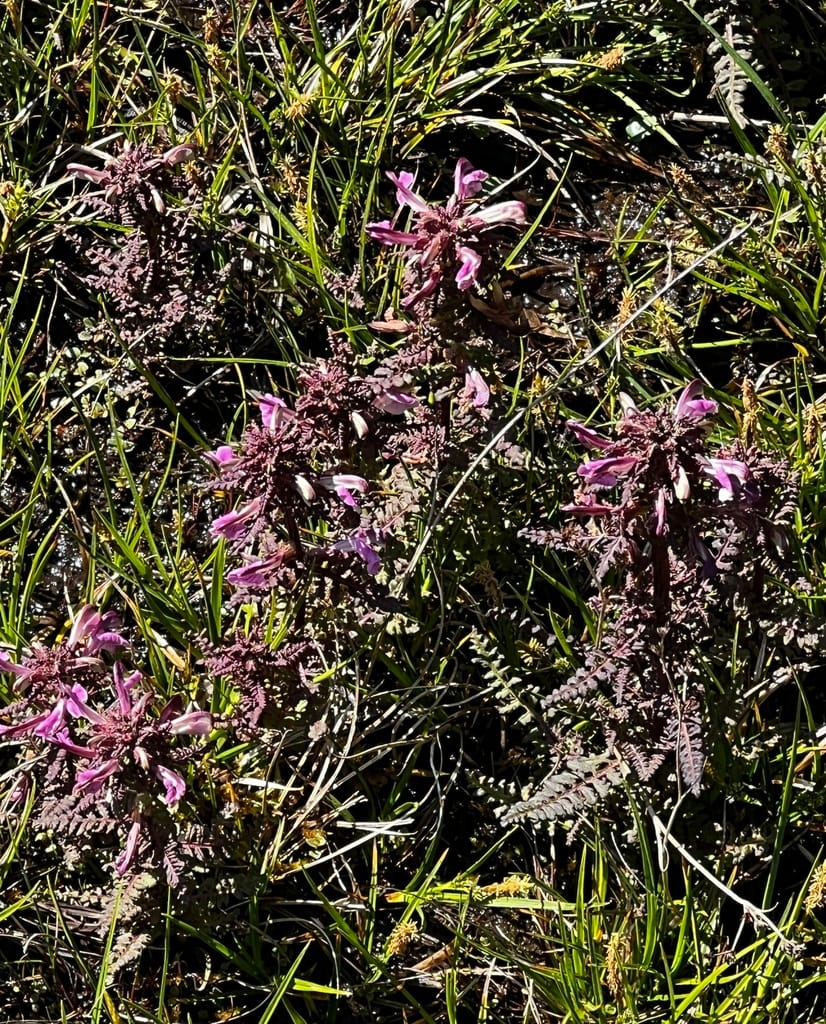
Marsh Lousewort is a biennial wetland plant that is partly parasitic on the roots of nearby plants. It is found in damp meadows and marshy shores across northern and central Europe and into western Russia. In summer it stands out with reddish stems and rows of purple-red, tube-shaped flowers.
Did you know?
- It is a half-parasite that taps neighbouring plants’ roots for water and nutrients.
- Flowers are usually red, but rare plants can be pale yellowish white.
About the species
Identification
Biennial, partly parasitic herb, 20–80 cm tall. Stem smooth, often brown‑red. Basal rosette often large; leaves triangular and cut into many narrow segments. Along the stem, many narrow leaves with paired side teeth or segments. Flower cluster long at the top, often loose below; side branches may also carry flowers. Flowers 1.5–2.2 cm, tube‑shaped with two lips: the upper forms a hood, the lower has three lobes; usually violet‑red, sometimes pale yellowish white. Fruit a small oval pod with many seeds. The red, hooded flowers in a long top cluster help tell it from other louseworts. Flowers in mid to late summer (June–August).
Plant group
Herbaceous plants
Habitat
shore, mire
Flowering
Jun–Aug
About the habitat
Wet meadows and fens, and marshy lake and river shores; also coastal meadows. Common throughout Finland; two subspecies occur in the south and a northern subspecies in the north.
Sources
Photo: janh11, CC0 1.0 https://www.gbif.org/occurrence/6234331223
Text: Pinkka: Laaja maatalouslajintuntemus 4 op - Koppisiemeniset, CC BY 4.0 https://laji.fi/taxon/MX.39658
Text: Wikipedia (Finnish), CC BY-SA 4.0 https://fi.wikipedia.org/wiki/Luhtakuusio