 Suomi
 Svenska
Lyme-Grass
Leymus arenarius
Identify the Lyme-Grass from a photo and log your finds with Florapass.
Coming soon to the App Store and Google Play.
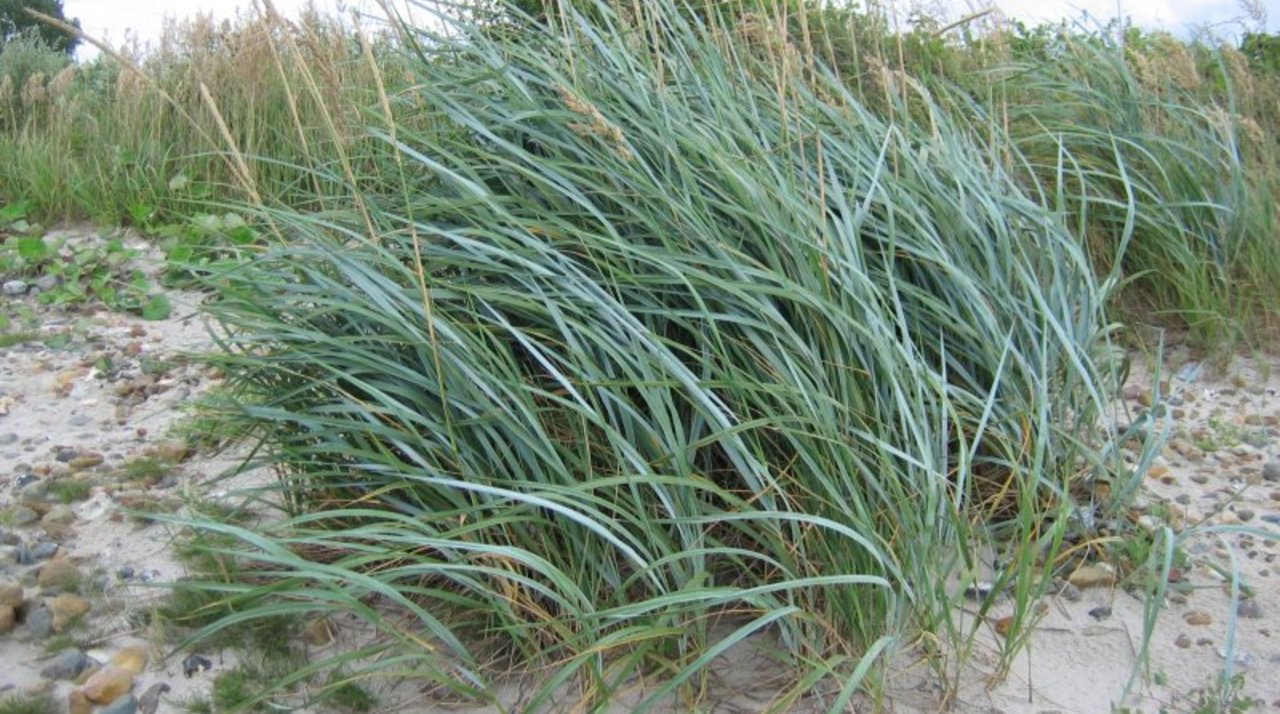
Lyme-Grass is a tall, blue‑green grass of sandy seashores and dunes. It spreads by long underground runners and often forms dense patches that help hold the sand. Its flowering head is a thick, wheat‑like spike that turns pale straw‑yellow as it ripens.
Did you know?
- Very tolerant of sea spray and road salt, so it can also colonise salty roadsides and railway embankments.
- It is wind‑pollinated.
About the species
Identification
Lyme‑Grass is a tall, stiff grass (50–150 cm). Stems are upright, smooth and blue‑green. Leaves are broad for a dune grass, about 1 cm wide, stiff and flat or with edges rolled upward; the top feels rough and the underside smooth. It spreads by long underground runners, forming dense patches. The flower head is a long, dense, wheat‑like spike (15–30 cm) that ripens to pale straw yellow and looks broad and flat‑sided. Compare with Marram grass: its leaves are very tightly rolled and its head slimmer. Flowers in Finland in late summer, July–August.
Plant group
Grasses, sedges and rushes
Habitat
shore
Flowering
Jul–Aug
About the habitat
Grows on sandy seashores and coastal dunes; also along salty roadsides and railway embankments; only rarely on lake shores. Common along the Baltic coast; inland occasional, usually a newcomer.
Sources
Photo: Kristian Peters -- Fabelfroh 09:25, 14 October 2005 (UTC), CC BY-SA 3.0 https://commons.wikimedia.org/wiki/File:Leymus arenarius habitus.jpeg
Text: Pinkka: BIO-503 Suomen kasvisto ja kasvillisuus - Itämeri: hiekkarannat, CC BY 4.0 https://laji.fi/taxon/MX.40530
Text: Wikipedia (Finnish), CC BY-SA 4.0 https://fi.wikipedia.org/wiki/Rantavehn%C3%A4