 Suomi
 Svenska
Floating Sweet-Grass
Glyceria fluitans
Identify the Floating Sweet-Grass from a photo and log your finds with Florapass.
Coming soon to the App Store and Google Play.
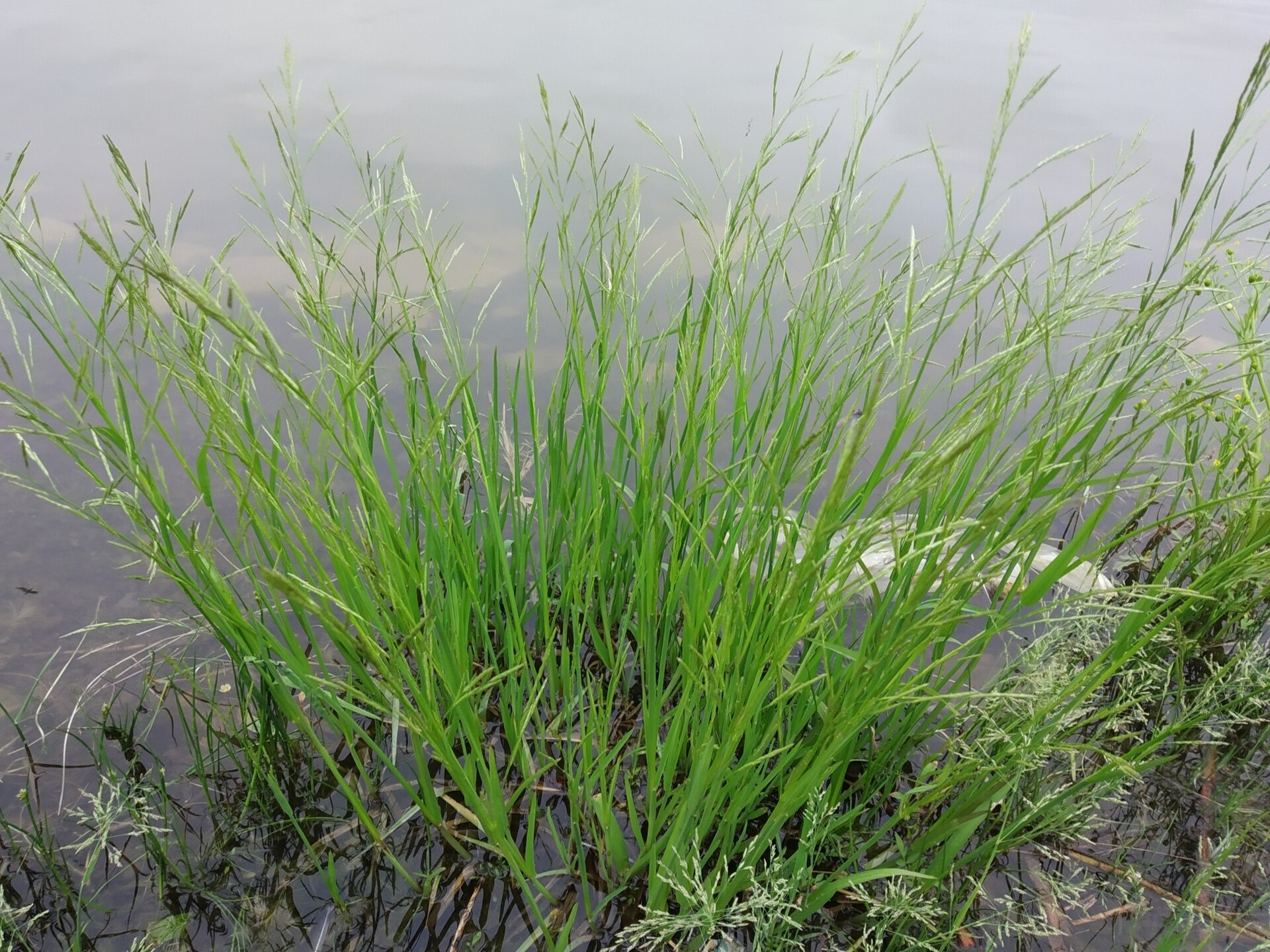
Floating Sweet-Grass is a water-edge grass that often grows with its roots in shallow water and its long leaves floating on the surface. It is a perennial forming loose tufts and can reach about 1 m tall. The flower head is long, very narrow and slightly one-sided, often bending over.
Did you know?
- Its Latin name fluitans means “floating”, referring to leaves that often lie on the water.
- It can form hybrids with another sweet-grass (Glyceria notata).
About the species
Identification
Loose tufts, 50–100 cm tall. Stems hollow, upright but often bending at the tip, smooth. Leaves flat, fairly wide (about 4–8 mm), pale green above and dull beneath; in water they can grow very long and float. A large pale flap is visible where the leaf meets the stem. The flower head is 25–50 cm, long and very narrow with short side branches mostly to one side, often slightly drooping and later closing. Tiny purple-tinted pollen sacs may be seen. Flowers in Finland in June–July.
Plant group
Grasses, sedges and rushes
Habitat
shore
Flowering
Jun–Jul
About the habitat
Shallow water and muddy edges of lakes and slow rivers, ponds, ditches and wet hollows; also on trampled boat and cattle shores. Common in southern and central Finland, rare in the north.
Sources
Photo: Елена Смирнова, CC BY 4.0 https://commons.wikimedia.org/wiki/File:Glyceria fluitans 78503925.jpg
Text: Pinkka: BIO-503 Suomen kasvisto ja kasvillisuus - Sisävedet: rantaniityt, CC BY 4.0 https://laji.fi/taxon/MX.40515
Text: Pinkka (Luomus), CC BY 4.0 https://laji.fi/taxon/MX.40515
Text: Wikipedia (Finnish), CC BY-SA 4.0 https://fi.wikipedia.org/wiki/Ojasorsimo