 Suomi
 Svenska
Japanese knotweed
Reynoutria japonica
Identify the Japanese knotweed from a photo and log your finds with Florapass.
Coming soon to the App Store and Google Play.
Invasive alien species – remove it if you can
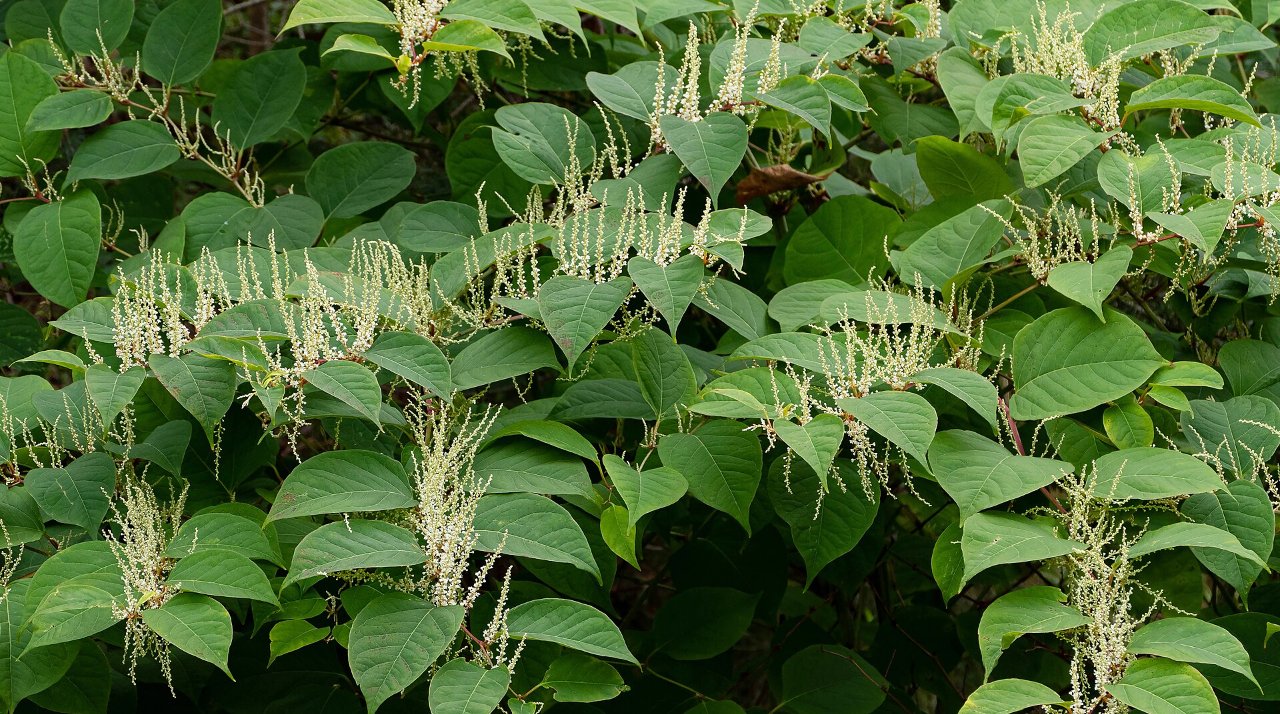
Japanese knotweed is a tall, fast-growing perennial that forms dense stands. It has hollow, bamboo-like stems and sprays of small whitish flowers late in the season. Native to East Asia, it is now widely seen along roadsides, riverbanks and waste ground, often spreading from old plantings. In many regions it is regarded as a harmful invasive species.
Did you know?
- Its hollow, jointed stems look like bamboo.
- In many places it spreads mainly from small pieces of its deep root system, not from seed.
About the species
Identification
Tall perennial forming dense patches, usually 1–2 m. Stems hollow, green to reddish, with knotty joints and few side branches near the top. Leaves 7–15 cm, broadly triangular to egg-shaped with a flat or blunt base and a long narrow tip; upper side green to yellow‑green, underside paler. Flowers in late summer–autumn: many small white to pale pinkish blossoms in airy clusters from the points where leaves join the stem. Seeds are small, three‑sided and dark brown but rarely ripen in cool climates. Larger relative giant knotweed has much bigger, heart‑based leaves; the hybrid is in between. Flowers in Finland in September–October.
Plant group
Herbaceous plants
Habitat
yards and roadsides, shore
Flowering
Sep–Oct
About the habitat
Thrives in sunny to half-shaded, disturbed places: riverbanks, roadsides, railways, dumps, embankments and abandoned gardens. Tolerates many soils, even heavy clay and poor ground. Mainly in southern Finland, scattered and local. Most records are in built‑up areas and settlements, often along roads and in new plantings; also as garden escapes.
Sources
Photo: W.carter, CC0 https://commons.wikimedia.org/wiki/File:Reynoutria japonica in Brastad 1.jpg
Text: Pinkka: A Pohjolan kasveja - Rabelera-Ruta, CC BY 4.0 https://laji.fi/taxon/MX.38240
Text: FinBIF species descriptions, CC BY 4.0 https://laji.fi/taxon/MX.38240
Text: Wikipedia (Finnish), CC BY-SA 4.0 https://fi.wikipedia.org/wiki/Japanintatar