 Suomi
 Svenska
Giant knotweed
Reynoutria sachalinensis
Identify the Giant knotweed from a photo and log your finds with Florapass.
Coming soon to the App Store and Google Play.
Invasive alien species – remove it if you can
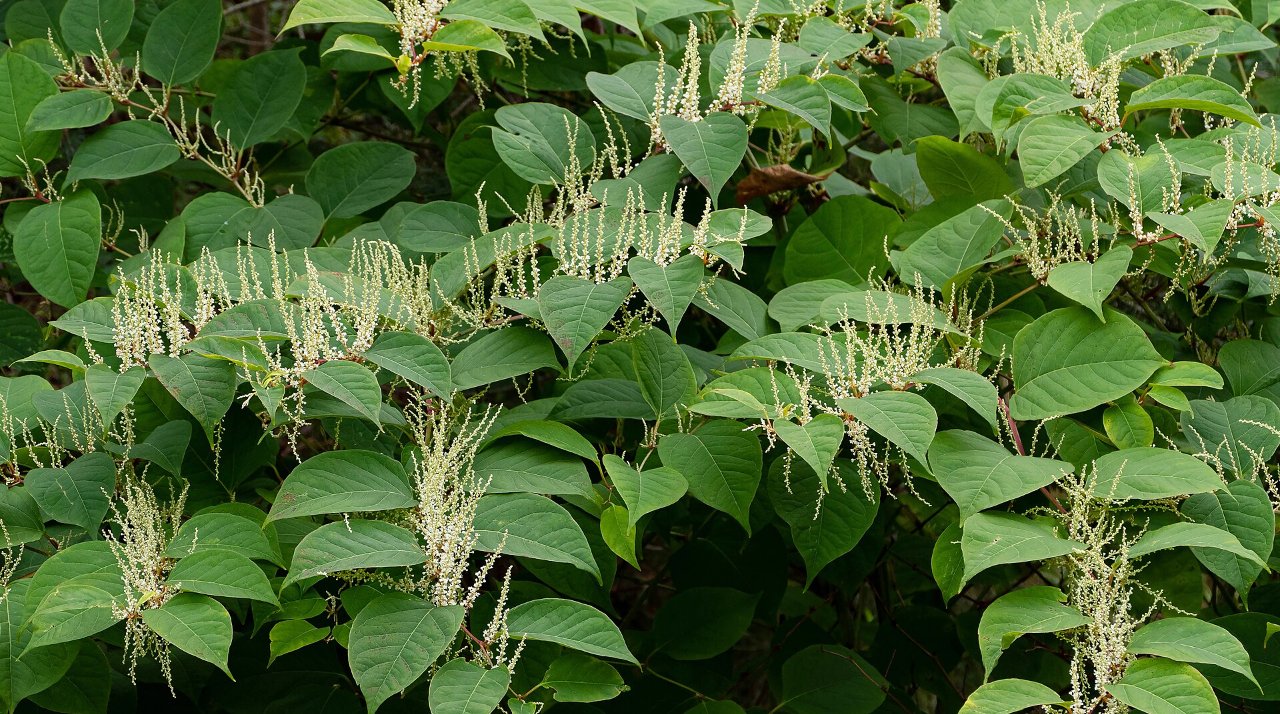
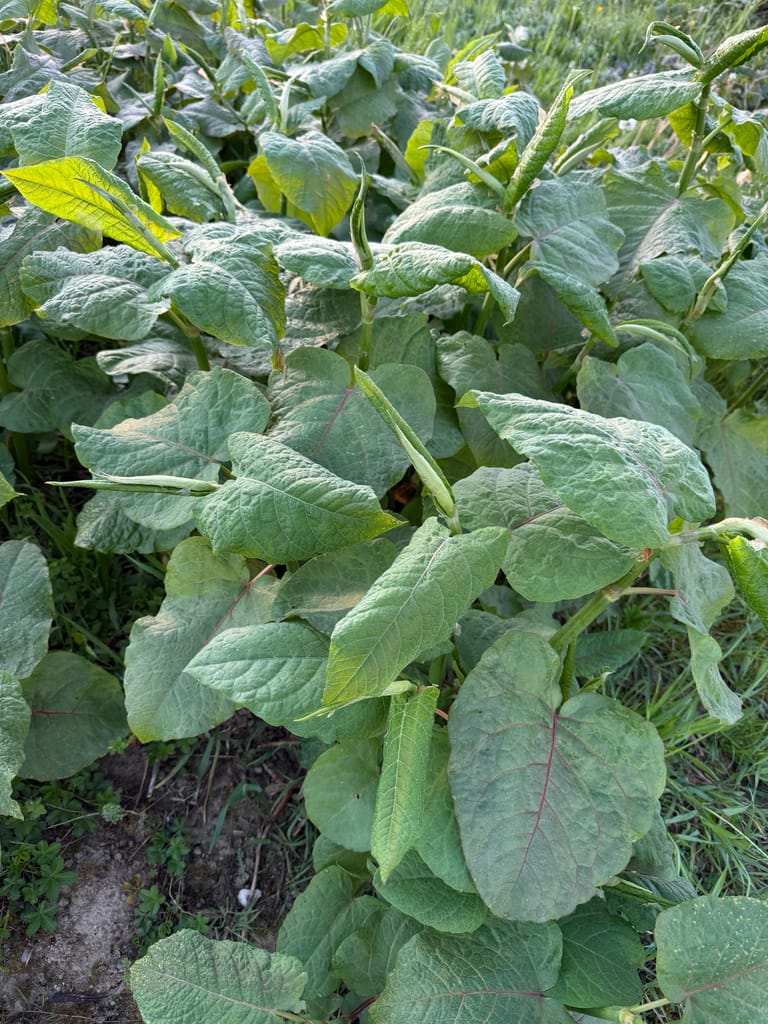
Giant knotweed is a very large, long‑lived plant from East Asia that forms tall, cane‑like stands. It has huge, heart‑based leaves and sprays of small whitish flowers late in the season. Widely planted as an ornamental, it has escaped and become an invasive weed in many regions.
Did you know?
- Its strong shoots can even push up through asphalt.
- New patches can grow from tiny pieces of its thick underground stems.
About the species
Identification
A towering, thicket‑forming perennial, usually 2–3 m tall. Stems are hollow, cane‑like, mostly unbranched below and branching near the top; green with a reddish tint or spots. Leaves are large (often 20–30 cm), long‑pointed with a distinctly heart‑shaped base; upper surface grey‑green. Small off‑white to greenish flowers stand in short upright sprays from the upper leaf joints in late summer to autumn. The small triangular seeds sit inside the flower parts and often fail to develop in cool climates. Compared with Japanese knotweed, giant knotweed is taller with larger leaves whose bases are clearly heart‑shaped; the hybrid is intermediate. Flowers in Finland in September–October.
Plant group
Herbaceous plants
Habitat
yards and roadsides, shore
Flowering
Sep–Oct
About the habitat
Grows on disturbed, nutrient‑rich ground: garden edges, parks, roadsides, railways, riverbanks and waste ground. Often near settlements, especially where soil has been moved. Mainly in southern Finland; occurrences concentrated in towns and scattered rural areas, spreading locally from plantings. Also along watercourses.
Sources
Photo: Martin Scheidleder, CC BY 4.0 https://www.gbif.org/occurrence/6235765488
Text: Pinkka: A Pohjolan kasveja - Rabelera-Ruta, CC BY 4.0 https://laji.fi/taxon/MX.38241
Text: FinBIF species descriptions, CC BY 4.0 https://laji.fi/taxon/MX.38241
Text: Wikipedia (Finnish), CC BY-SA 4.0 https://fi.wikipedia.org/wiki/J%C3%A4ttitatar