 Suomi
 Svenska
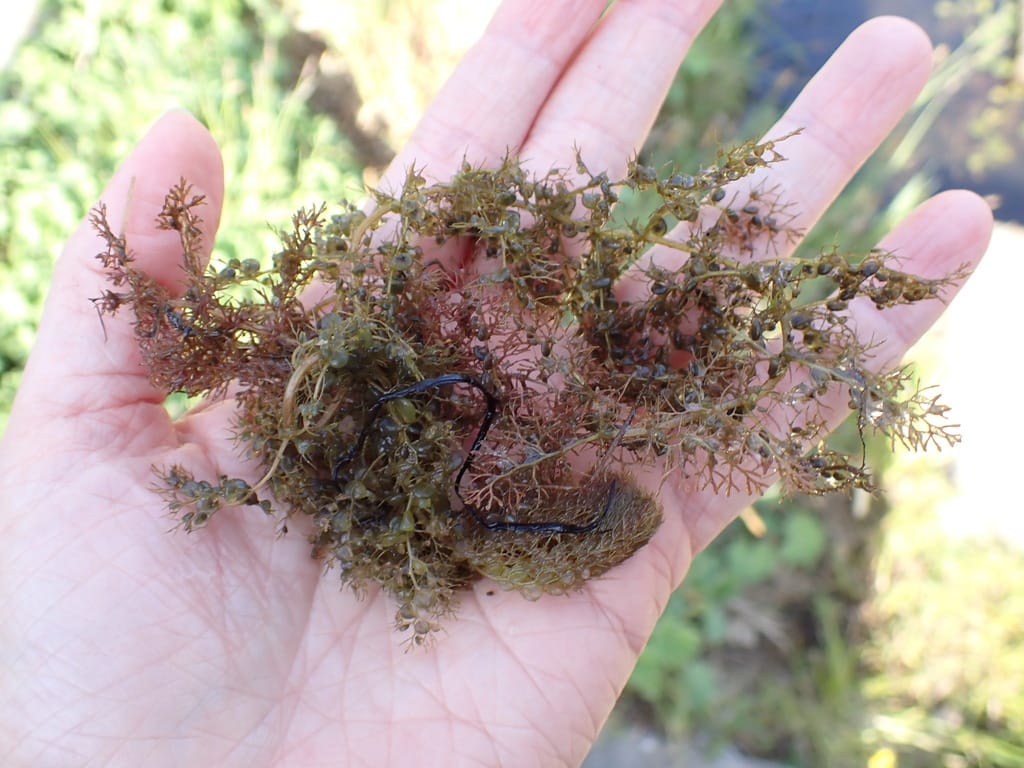
Greater Bladderwort
Utricularia vulgaris
Identify the Greater Bladderwort from a photo and log your finds with Florapass.
Coming soon to the App Store and Google Play.
Greater Bladderwort is a rootless, free‑floating carnivorous water plant. It drifts in still or slow waters and lifts bright yellow flowers above the surface in summer. Underwater, its feathery leaves carry tiny bladders that catch small water animals.
Did you know?
- Its tiny bladders work like suction traps, snapping prey inside in a split second.
- In autumn it forms tight winter buds that sink to the bottom and float up again in spring.
About the species
Identification
Slender, rootless plant floating free, with trailing stems about 20–100 cm. Leaves are finely divided into many hair‑thin pieces and may look dark green to brownish or reddish; small round bladders hang from the leaf tips. A straight stalk rises above the surface with several bright yellow, two‑lipped flowers, each with a small backward‑pointing spur. Look‑alikes are other bladderworts; this species is larger and its traps are relatively big (about 2–3 mm), often visible as tiny beads. Flowers in late summer, mainly July–August.
Plant group
Herbaceous plants
Habitat
water
Flowering
Jul–Aug
About the habitat
Grows in shallow, sheltered water: quiet edges of lakes and rivers, backwaters and bays with a little salt, ponds, ditches and slow streams. Common across Finland except rare in northernmost Lapland.
Sources
Photo: Ellyne Geurts, CC0 1.0 https://www.gbif.org/occurrence/6252588124
Text: Pinkka: Laaja maatalouslajintuntemus 4 op - Koppisiemeniset, CC BY 4.0 https://laji.fi/taxon/MX.39693
Text: Pinkka (Luomus), CC BY 4.0 https://laji.fi/taxon/MX.39693
Text: Wikipedia (Finnish), CC BY-SA 4.0 https://fi.wikipedia.org/wiki/Isovesiherne