 Suomi
 Svenska
Common Eyebright
Euphrasia nemorosa
Identify the Common Eyebright from a photo and log your finds with Florapass.
Coming soon to the App Store and Google Play.
Alien species
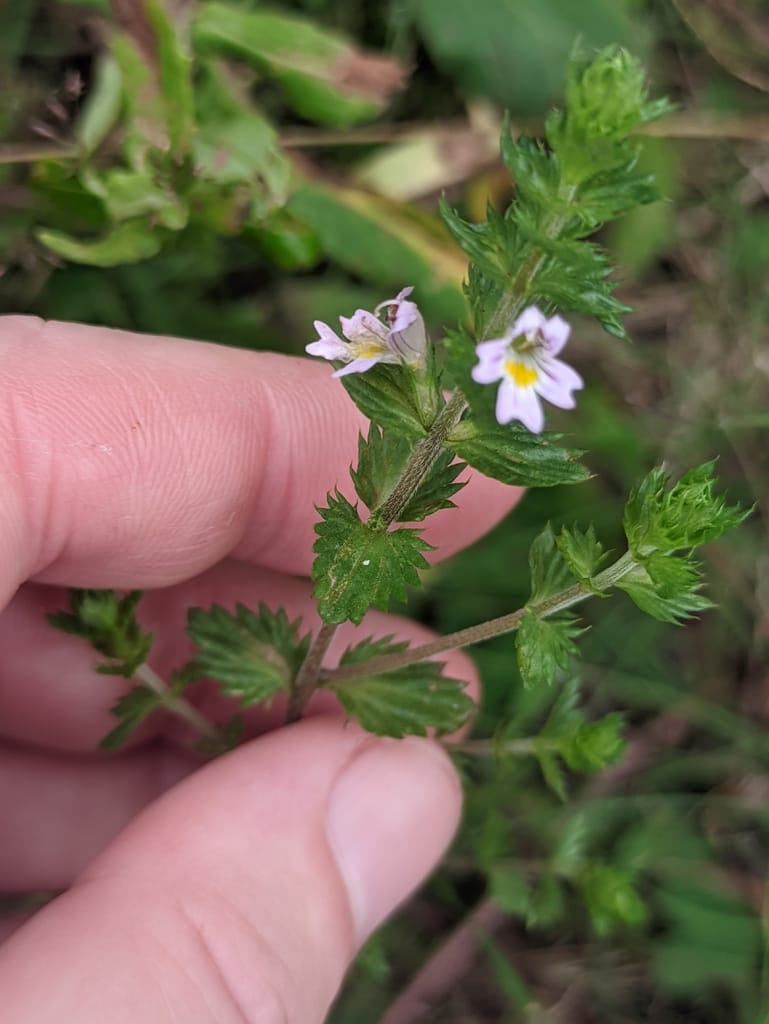
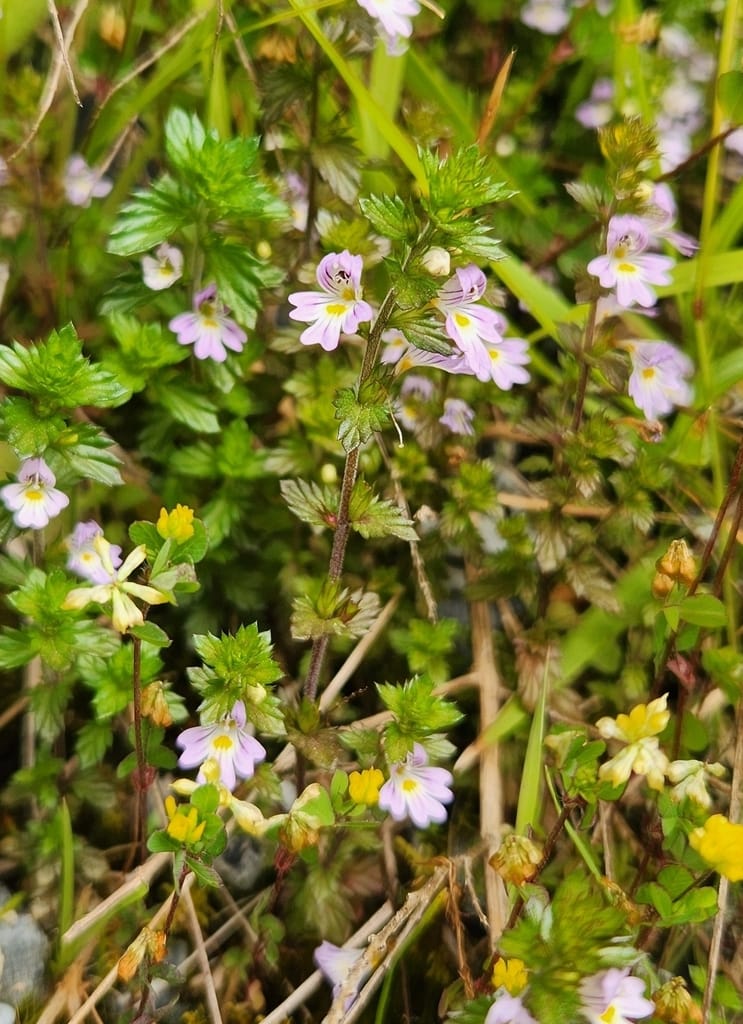
Common Eyebright is a small, hemiparasitic annual wildflower in the broomrape family. It is native to Europe and has also been introduced to parts of North America and New Zealand. You’ll most often notice it in summer into early autumn, when its tiny white to pale lilac, purple‑veined flowers with a yellow blotch appear in short grass and heathy places.
Did you know?
- Common Eyebright taps into the roots of nearby plants for water and nutrients but still makes its own food through photosynthesis.
- Its name reflects a long-standing folklore association with eyesight, echoed in the flower’s eye-like yellow ‘pupil’ and guiding veins.
About the species
Identification
A low, branching annual with opposite, small, toothed leaves. Flowers are small and two-lipped, usually white to pale lilac with fine purple veins and a distinct yellow patch on the lower lip; they sit in the leaf axils along the stems. Fruits are small capsules. Typically flowers from mid-summer into autumn; the combination of toothed opposite leaves and white, purple-veined, yellow-throated blooms is characteristic of Common Eyebright.
Plant group
Herbaceous plants
Habitat
meadow
Flowering
Jul–Sep
About the habitat
Found in open, sunny to lightly shaded places with short vegetation, such as well-drained grasslands, heaths, and other low, grazed or mown turf where suitable host plants are present.
Sources
Photo: alamettyr, CC BY 4.0 https://www.gbif.org/occurrence/5938215552
Text: Wikipedia (English), CC BY-SA 4.0 https://en.wikipedia.org/wiki/Euphrasia_nemorosa