 Suomi
 Svenska
Bush Vetch
Vicia sepium
Identify the Bush Vetch from a photo and log your finds with Florapass.
Coming soon to the App Store and Google Play.
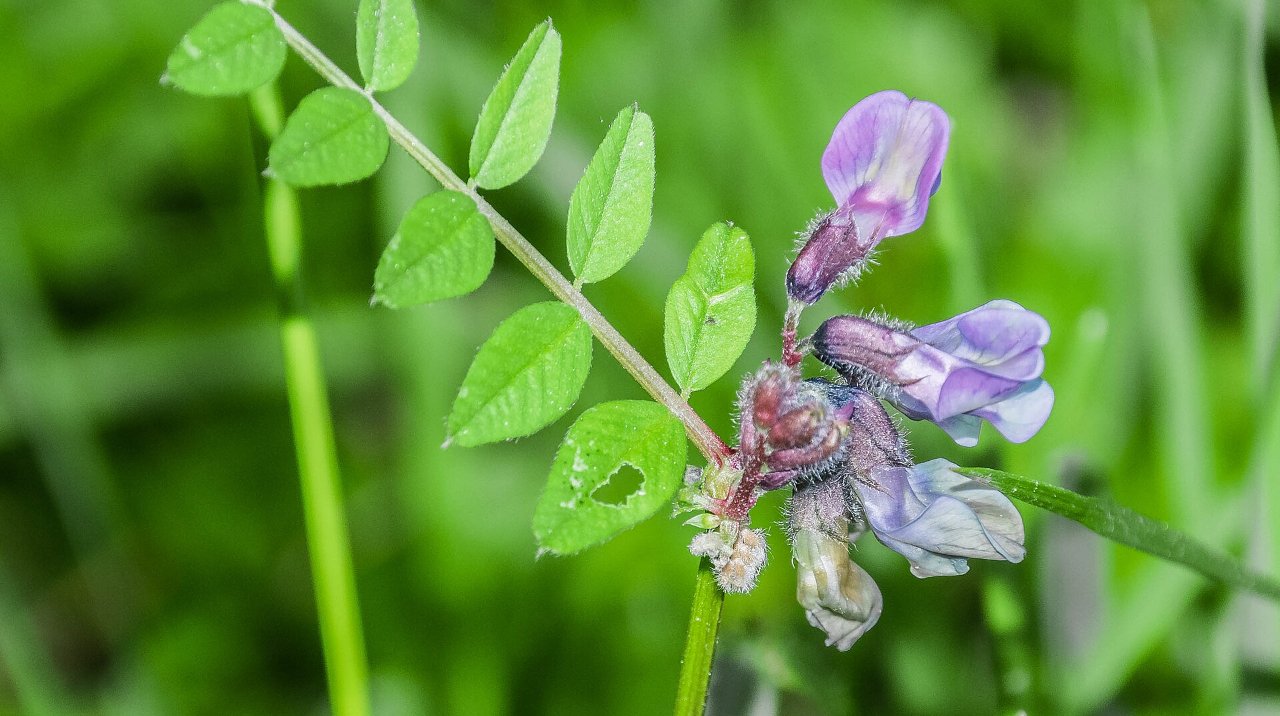
Bush Vetch is a slender, climbing perennial in the pea family with violet to blue‑purple flowers. It sprawls through grass and shrubs, gripping with coiling tips. You can see it in meadows, field edges, woodland edges, roadsides and shores. It is poisonous.
Did you know?
- It has two subspecies.
- Pollinated by insects, often bees.
About the species
Identification
A nearly hairless climber, 30–60 cm, leaning on other plants. Leaves have 4–8 pairs of oval leaflets, widest near the base, and end in a small curling tendril (a thin clasping tip). At the base of each leaf are small smooth side flaps with a dark spot. Short stalks hold tiny clusters of 2–5 pea‑like flowers, about 1–1.5 cm, violet to blue‑purple with a paler top petal. Later, narrow pods 2–3 cm turn black and contain several round brown seeds. Compared with tufted vetch, bush vetch has fewer leaflets and much smaller flower clusters (2–5 flowers, not long drooping clusters). Flowers in Finland from June to August.
Plant group
Herbaceous plants
Habitat
meadow
Toxicity
A poisonous plant – do not taste it. Source: HUS Poison Information Centre (Finland), tel. 0800 147 111.
Flowering
Jun–Aug
About the habitat
Found in meadows and pastures, hedges and field margins, roadsides, shores and riverbanks, and light or fresh woodland and groves; it favors moist to fresh, fairly rich soils. Common across Finland except Lapland, where it is rare (especially northern Lapland).
Sources
Photo: Krzysztof Golik, CC BY-SA 4.0 https://commons.wikimedia.org/wiki/File:Vicia sepium in Aveyron 02.jpg
Text: Pinkka: Verso- ja leviäintunnistus - Kaikki leviäimet, CC BY 4.0 https://laji.fi/taxon/MX.38980
Text: Pinkka: Laaja maatalouslajintuntemus 4 op - Koppisiemeniset, CC BY 4.0 https://laji.fi/taxon/MX.38980
Text: Pinkka: IPS-153 Flora of Subarctic Europe - Tanacetum-Viscaria, CC BY 4.0 https://laji.fi/taxon/MX.38980
Text: Wikipedia (Finnish), CC BY-SA 4.0 https://fi.wikipedia.org/wiki/Aitovirna