 Suomi
 Svenska
Bulrush
Typha latifolia
Identify the Bulrush from a photo and log your finds with Florapass.
Coming soon to the App Store and Google Play.
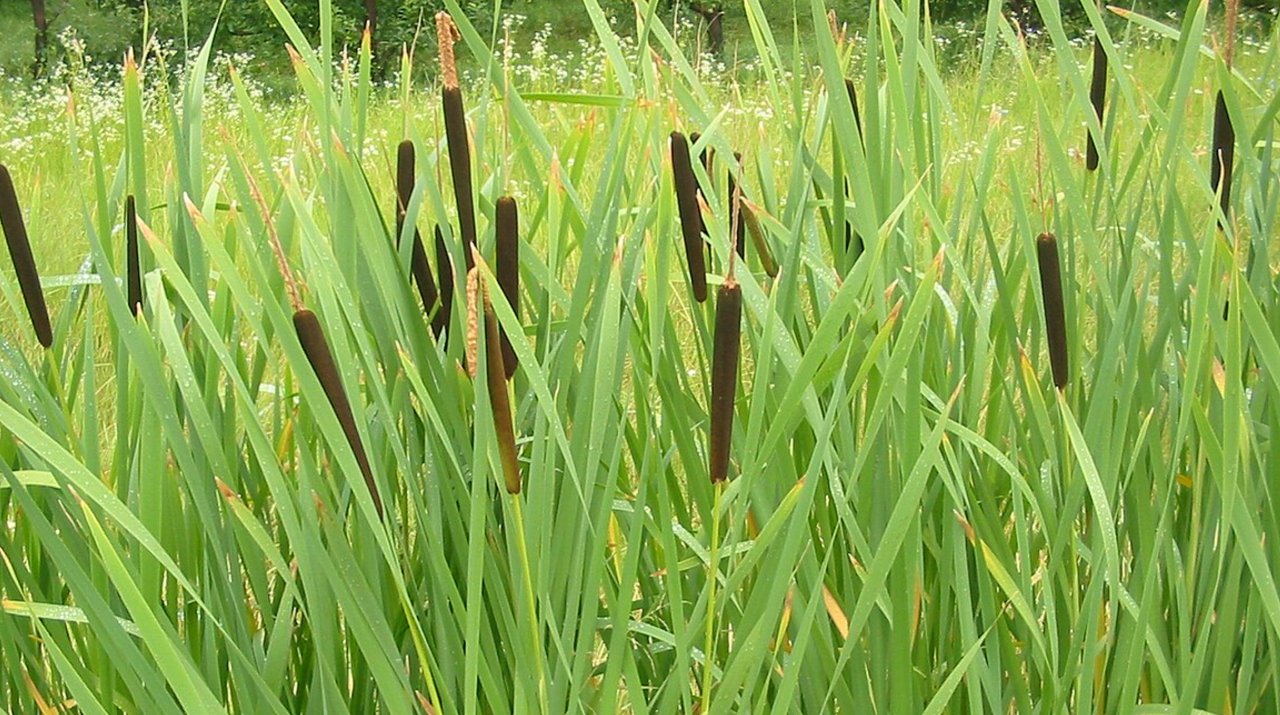
Bulrush is a tall waterside plant with the classic dark brown, sausage‑shaped heads at the top of its stems. It is common along the edges of lakes, slow rivers and ditches, and is found across much of Europe and North America.
Did you know?
- Each brown head is made of thousands of tiny flowers that later turn into cottony fluff.
- Stands of bulrush provide shelter and nesting material for many wetland birds.
About the species
Identification
Usually 1–1.5 m tall, with a thick, upright, unbranched stem. Leaves are long, flat, stiff and bluish‑green, mostly from the base, about 1–2 cm wide. At the stem tip sits a tight two‑part cylinder: a yellowish pollen section on top and a dark brown “sausage” below, touching with no gap. Later the brown part breaks into cottony fluff that carries many tiny seeds. Compare with Narrowleaf Bulrush (Typha angustifolia), which has slimmer leaves and a clear gap between the upper and lower parts. Flowers in Finland in July–August.
Plant group
Grasses, sedges and rushes
Habitat
yards and roadsides, shore
Flowering
Jul–Aug
About the habitat
Shallow water and muddy edges of lakes and slow rivers, ditches, ponds and brackish bays; sometimes on very wet ground. It thrives in nutrient‑rich water. Common in southern and central Finland; reaches its northern limit around the inner Bothnian Bay.
Sources
Photo: User:Bogdan, CC BY-SA 3.0 https://commons.wikimedia.org/wiki/File:Typha latifolia 02 bgiu.jpg
Text: Pinkka: BIO-503 Suomen kasvisto ja kasvillisuus - Sisävedet: runsasravinteiset järvet, CC BY 4.0 https://laji.fi/taxon/MX.40188
Text: Pinkka: Pieni maatalouslajintuntemus - Puuvartiset, CC BY 4.0 https://laji.fi/taxon/MX.40188
Text: Wikipedia (Finnish), CC BY-SA 4.0 https://fi.wikipedia.org/wiki/Leve%C3%A4osmank%C3%A4%C3%A4mi