 Suomi
 Svenska
White Water-Lily
Nymphaea alba
Identify the White Water-Lily from a photo and log your finds with Florapass.
Coming soon to the App Store and Google Play.
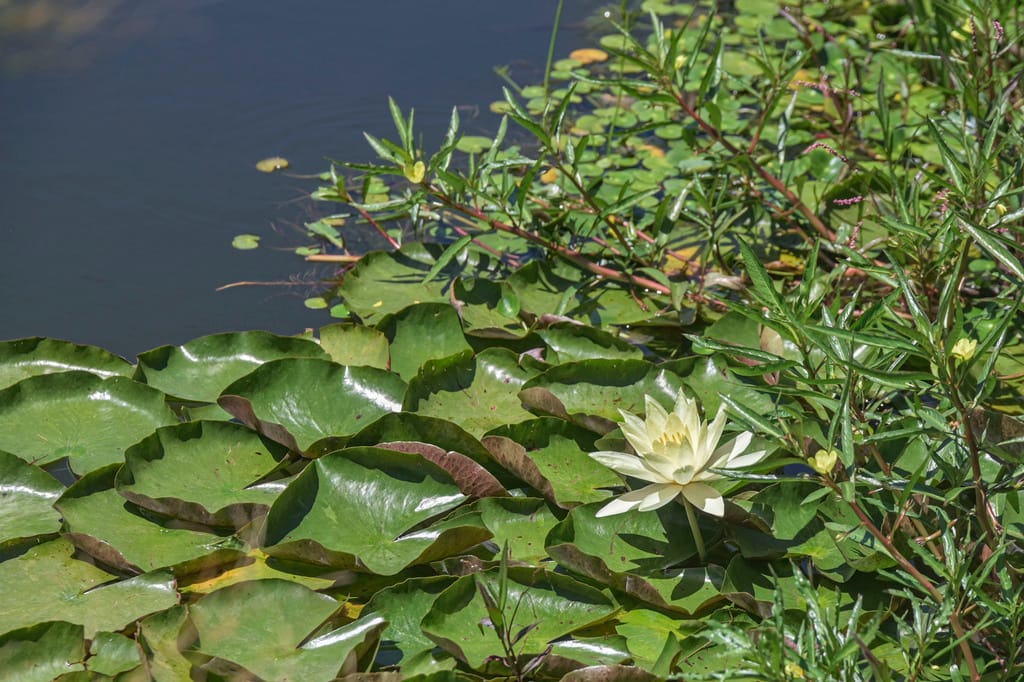
White Water-Lily is a perennial, floating‑leaved aquatic plant with showy white, many‑petalled flowers. It is widespread across much of Europe and extends into parts of western Asia, appearing on still or slow waters. The blossoms are most often seen in the warmer months of the year, when they open on calm, sunny days. Like other water‑lilies, it is poisonous if eaten due to alkaloids in the tissues.
Did you know?
- The flowers open by day and close at night, and may stay shut in cloudy weather.
- After pollination, the flower stalk coils and pulls the fruit under water to ripen, with seeds later dispersing as floating fragments break apart.
About the species
Identification
A robust, rhizomatous aquatic with long, round leaf stalks bearing glossy, floating, round to broadly heart‑shaped leaves that have a deep notch at the base; the upper surface is green and the underside can be green to reddish. Flowers are large, cup‑to‑half‑sphere shaped, usually pure white with many narrow petals and a yellow center, floating at or just above the surface and sweetly scented. After flowering, the stalk coils and submerges the developing, globular fruit. It is told from yellow‑flowered water‑lilies by its white petals, and from similar white water‑lilies by its generally larger, thicker leaves and flowers with many slender petals.
Plant group
Herbaceous plants
Habitat
water
Flowering
Jul–Sep
About the habitat
Grows rooted in soft, silty or muddy bottoms of ponds, lakes, canals, and sheltered bays, typically in still or slow‑moving fresh water; it can also tolerate slightly brackish inlets.
Sources
Photo: Алексей Логинов, CC BY 4.0 https://www.gbif.org/occurrence/6170991285
Text: Wikipedia (Finnish), CC BY-SA 4.0 https://fi.wikipedia.org/wiki/Isolumme