 Suomi
 Svenska
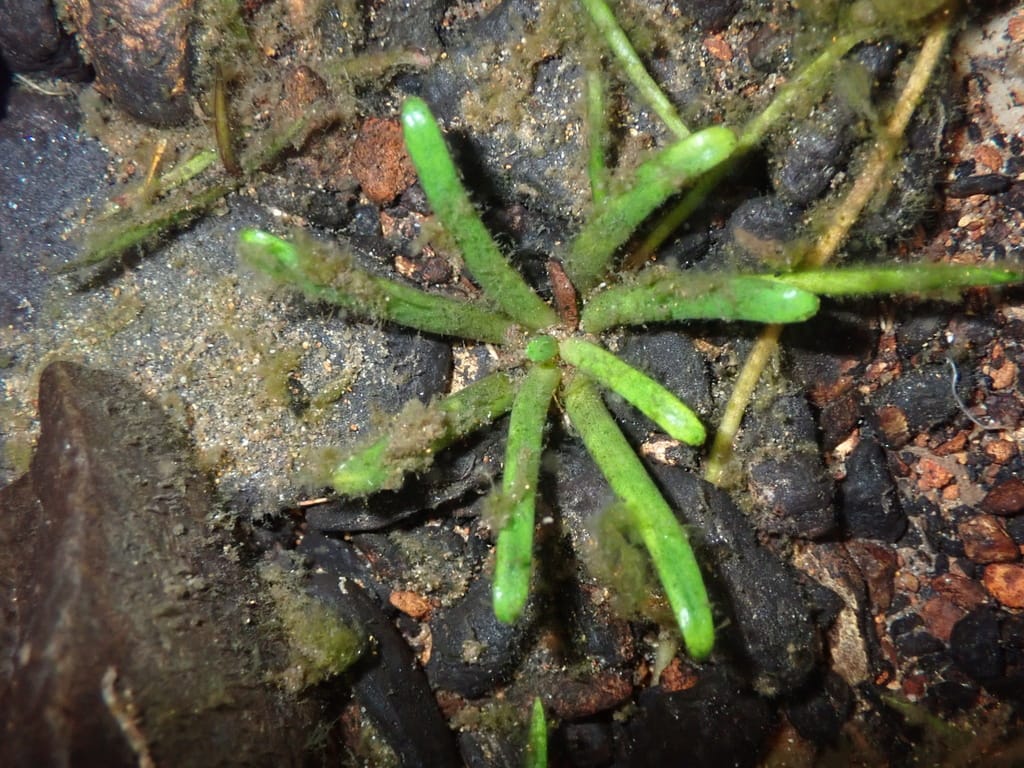
Water Lobelia
Lobelia dortmanna
Identify the Water Lobelia from a photo and log your finds with Florapass.
Coming soon to the App Store and Google Play.
Water Lobelia is an underwater plant of clear, low‑nutrient lakes. It sends up a thin stalk that rises above the surface with pale blue or almost white flowers in late summer. Poisonous.
Did you know?
- Often used as a sign of very clear, low‑nutrient lakes.
- It is related to the garden lobelia grown in flower boxes.
About the species
Identification
Forms a dense tuft of narrow, stiff, slightly curved leaves on the lake bottom. From this base a hollow, unbranched stalk 20–90 cm (sometimes taller) rises to the surface; the few small leaves on the stalk are easy to miss. Above the water the stalk bears a loose row of small, bell‑like flowers, pale blue to almost white, about 1–1.5 cm. Later it makes small hanging pods with many tiny seeds. Distinguished from quillworts and shoreweed by the tall, leafless flowering stalk with pale flowers above the surface in late summer. Flowers in Finland in July–August.
Plant group
Herbaceous plants
Habitat
water
Toxicity
A poisonous plant – do not taste it. Source: HUS Poison Information Centre (Finland), tel. 0800 147 111.
Flowering
Jul–Aug
About the habitat
Grows in clear, nutrient‑poor lakes, especially on sandy or gravel bottoms. Sometimes also in slow‑flowing waters and in river mouths where the water is only slightly brackish. Occurs across most of the country; rare on the Bothnian Bay coast and in southern Lapland, absent in northern Lapland, otherwise common.
Sources
Photo: Sean Hartnett, CC BY 4.0 https://www.gbif.org/occurrence/6130595986
Text: Pinkka: BIO-503 Suomen kasvisto ja kasvillisuus - Sisävedet: humusjärvet, CC BY 4.0 https://laji.fi/taxon/MX.39722
Text: Wikipedia (Finnish), CC BY-SA 4.0 https://fi.wikipedia.org/wiki/Nuottaruoho