 Suomi
 Svenska
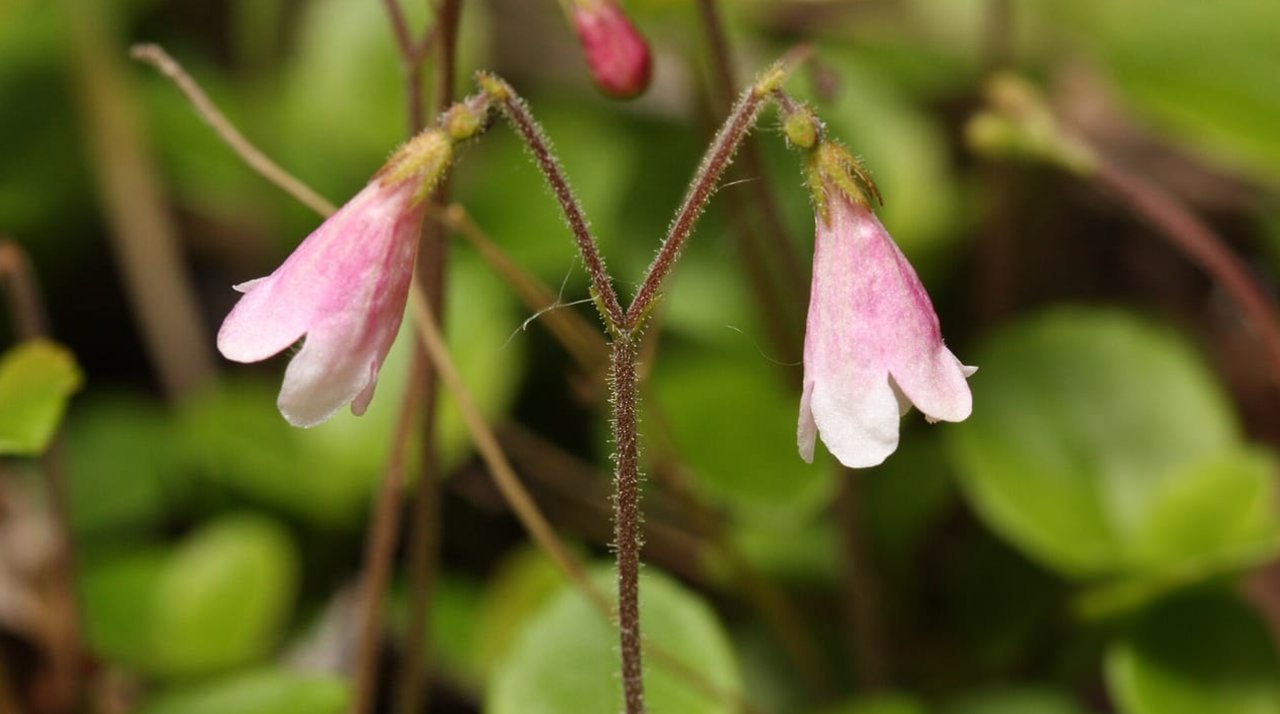
Twinflower
Linnaea borealis
Identify the Twinflower from a photo and log your finds with Florapass.
Coming soon to the App Store and Google Play.
Twinflower is a delicate, low evergreen of northern forests. Its long creeping stems carry pairs of small round leaves and, in early summer, pairs of pale pink, nodding bells with a sweet night-time scent. It grows in cool conifer woods across northern Europe, Asia and North America.
Did you know?
- The scientific name honors Carl Linnaeus, for whom this was a favorite plant.
- The flowers smell most strongly at night to attract pollinators.
About the species
Identification
Very low evergreen with thin, woody stems creeping over moss, often far beyond the visible tuft. Flowering shoots stand 5–15 cm tall. Leaves are small (about 0.5–1.5 cm), round to oval, in pairs, and stay green over winter. Each flowering shoot ends in a fork with two drooping, bell-shaped, pale pink flowers that smell sweet, especially at night. Later it forms a tiny hard seed. Easy to tell by the two matching bells on a Y‑shaped stalk; similar forest flowers usually have single bells. Flowers in Finland in June–July.
Plant group
Dwarf shrubs
Habitat
heath forest
Flowering
Jun–Jul
About the habitat
Grows on mossy ground in dry to fresh conifer forests, especially wide, old spruce woods. It prefers undisturbed, natural forest and is sensitive to heavy changes, though it may appear along paths and light clearings. Common throughout the country.
Sources
Photo: Walter Siegmund (talk), CC BY-SA 3.0 https://commons.wikimedia.org/wiki/File:Linnaea borealis 8803.JPG
Text: Pinkka: Yläkoulun Pinkka - Tuore kangasmetsä, CC BY 4.0 https://laji.fi/taxon/MX.39343
Text: Pinkka: BIO-503 Suomen kasvisto ja kasvillisuus - Metsät: tuoreet kankaat, CC BY 4.0 https://laji.fi/taxon/MX.39343
Text: Pinkka: Kaskadian kasveja - Kaksisirkkaiset, CC BY 4.0 https://laji.fi/taxon/MX.39343
Text: Pinkka: Kasvien talvi - Talvivihreät luonnonkasvit, CC BY 4.0 https://laji.fi/taxon/MX.39343
Text: Wikipedia (Finnish), CC BY-SA 4.0 https://fi.wikipedia.org/wiki/Vanamo