
 Suomi
 Svenska
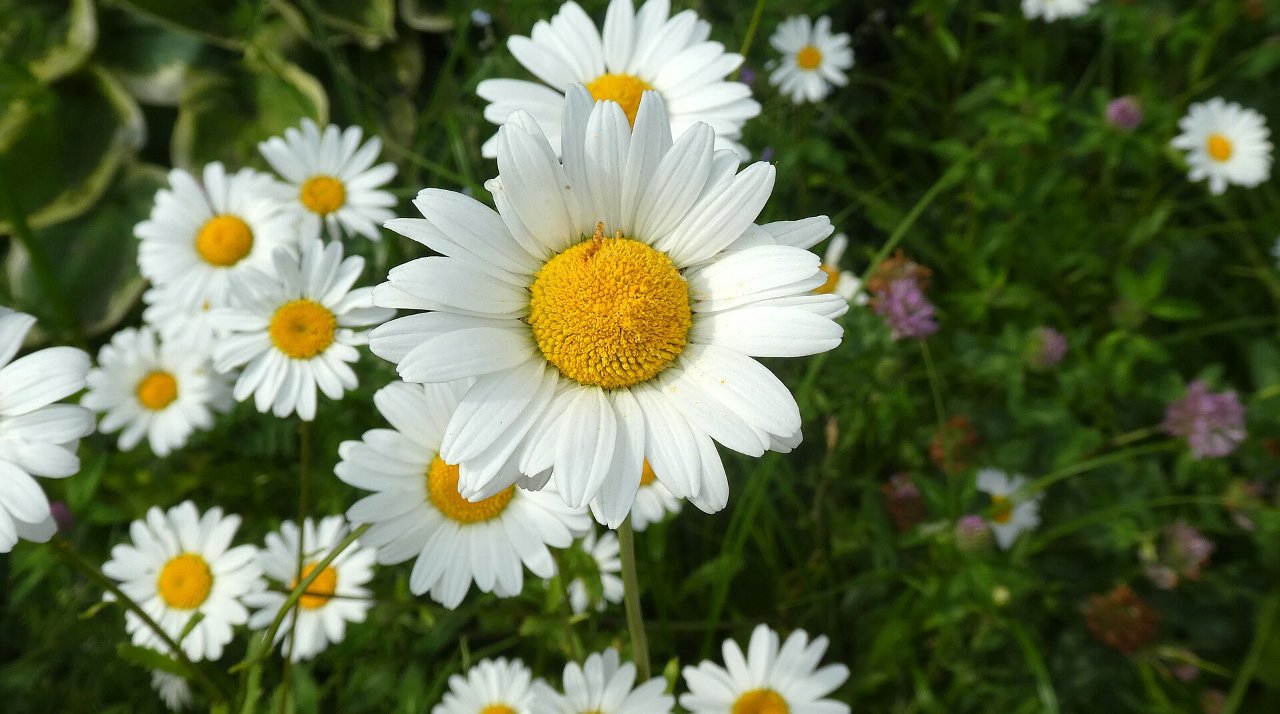
Oxeye Daisy
Leucanthemum vulgare
Identify the Oxeye Daisy from a photo and log your finds with Florapass.
Coming soon to the App Store and Google Play.
Alien species
Oxeye Daisy is a familiar white-and-yellow wildflower of open places. It grows along roadsides, in meadows and field edges across much of Europe and other temperate regions. Each plant often shows one big daisy-like flower head per stem, sometimes a few.
Did you know?
- Provincial flower of Central Finland.
- What looks like one flower is actually many tiny flowers: the white petals ring a tight yellow cluster.
About the species
Identification
Upright perennial, 20–70 cm. Stems smooth, usually unbranched, ending in one large daisy head (sometimes a few). A low clump of leaves at the base survives winter. Lower leaves on long stalks, broadest toward the tip and coarsely toothed; upper leaves with short or no stalk, narrower, toothed, sometimes with shallow side-lobes near the base. Flower heads 3–6 cm across with white petals around a yellow center. Seeds are small, hard, about 3 mm, without a fluffy tuft. Tell it from mayweeds and chamomile: they have feathery leaves, Oxeye Daisy’s are flat and toothed. Flowers in Finland from June to September.
Plant group
Herbaceous plants
Habitat
meadow
Flowering
Jun–Sep
About the habitat
Sunny, open ground such as meadows, pastures, field margins, lawns, roadsides and light forest edges; often in rather dry, not overly rich soils. Common in southern and central Finland; becomes scarce north of the Oulu–Kajaani line.
Sources
Photo: Екатерина Борисова, CC BY-SA 4.0 https://commons.wikimedia.org/wiki/File:Ромашка (нивяник) в саду Воскресенский церкви, Шушары 01.jpg
Text: Pinkka: Verso- ja leviäintunnistus - Kaikki leviäimet, CC BY 4.0 https://laji.fi/taxon/MX.39833
Text: Pinkka: BIO-503 Suomen kasvisto ja kasvillisuus - Kulttuuriympäristöt: niityt, CC BY 4.0 https://laji.fi/taxon/MX.39833
Text: Pinkka: Ålandsexkursion, CC BY 4.0 https://laji.fi/taxon/MX.39833
Text: Pinkka: Kasvien talvi - Talvivihreät luonnonkasvit, CC BY 4.0 https://laji.fi/taxon/MX.39833
Text: Wikipedia (Finnish), CC BY-SA 4.0 https://fi.wikipedia.org/wiki/Ahop%C3%A4iv%C3%A4nkakkara
 в саду Воскресенский церкви, Шушары 01.jpg)