 Suomi
 Svenska
Foxglove
Digitalis purpurea
Identify the Foxglove from a photo and log your finds with Florapass.
Coming soon to the App Store and Google Play.
Alien species
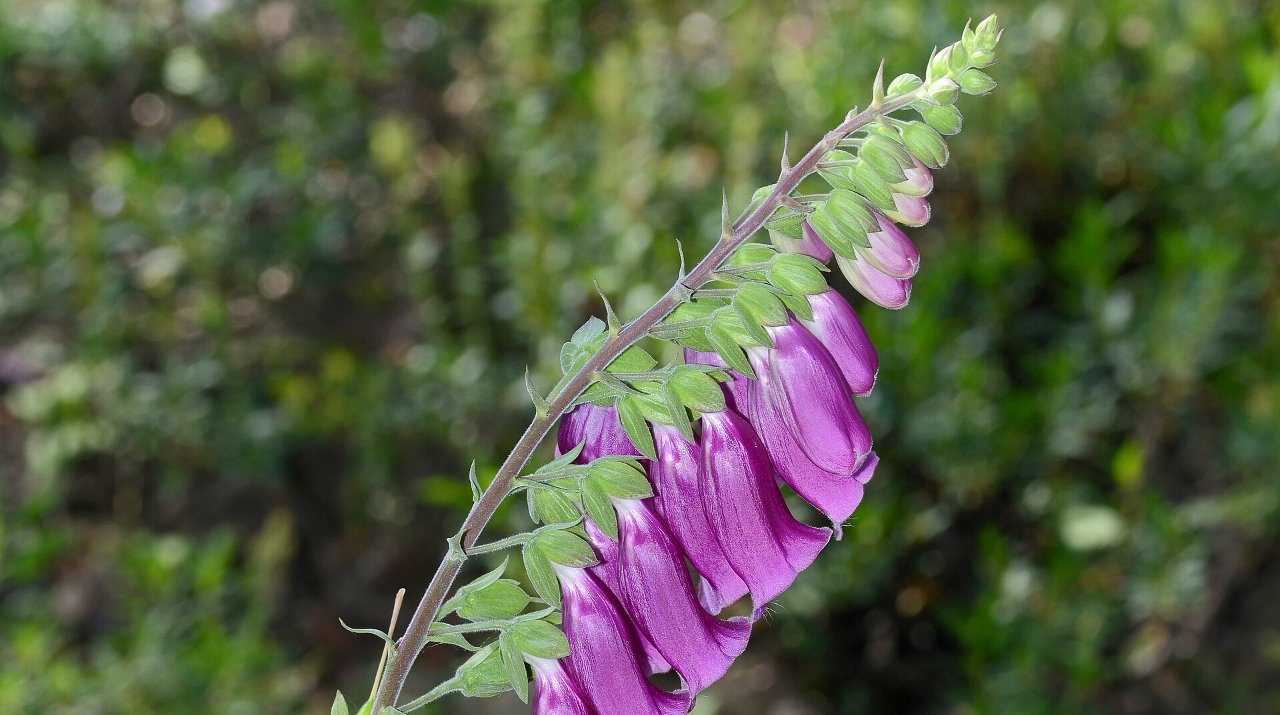
Foxglove is a tall, showy garden plant that often escapes and grows wild. It is usually a short‑lived biennial: leaves the first year, a tall flower stem the next. The long spike of hanging bell‑shaped flowers is most often purple, but can also be pink, white or pale yellow. All parts are very poisonous.
Did you know?
- Its thimble‑shaped flowers inspired the name “foxglove.”
- Compounds from foxglove were historically used to develop heart medicines.
About the species
Identification
First year it forms a low circle of soft, slightly hairy leaves at ground level. In the second year a single upright stem rises, often 60–150 cm. Stem leaves are smaller and point downward. The flowers hang in a long, one‑sided row near the top; each is a long bell shaped like a fingertip thimble. Colors are usually purple to pink, sometimes white or pale yellow. After flowering, dry pods form with many tiny seeds. Similar yellow‑flowered foxgloves exist, but this species most often has purple or pink blooms. Flowers in Finland in June–July.
Plant group
Herbaceous plants
Habitat
rock, heath forest, yards and roadsides
Toxicity
A very poisonous plant – do not taste any part of it. Source: HUS Poison Information Centre (Finland), tel. 0800 147 111.
Flowering
Jun–Jul
About the habitat
Commonly grown in gardens and old plantings; can spread to roadsides, forest edges, clearings and other disturbed, light places.
Sources
Photo: Alvesgaspar, CC BY-SA 3.0 https://commons.wikimedia.org/wiki/File:Digitalis July 2013-1.jpg
Text: Pinkka: BIO-516 Hyötykasvit - Rohdos- ja lääkekasveja, CC BY 4.0 https://laji.fi/taxon/MX.39597
Text: Wikipedia (Finnish), CC BY-SA 4.0 https://fi.wikipedia.org/wiki/Rohtosormustinkukka