 Suomi
 Svenska
Common Reed
Phragmites australis
Identify the Common Reed from a photo and log your finds with Florapass.
Coming soon to the App Store and Google Play.
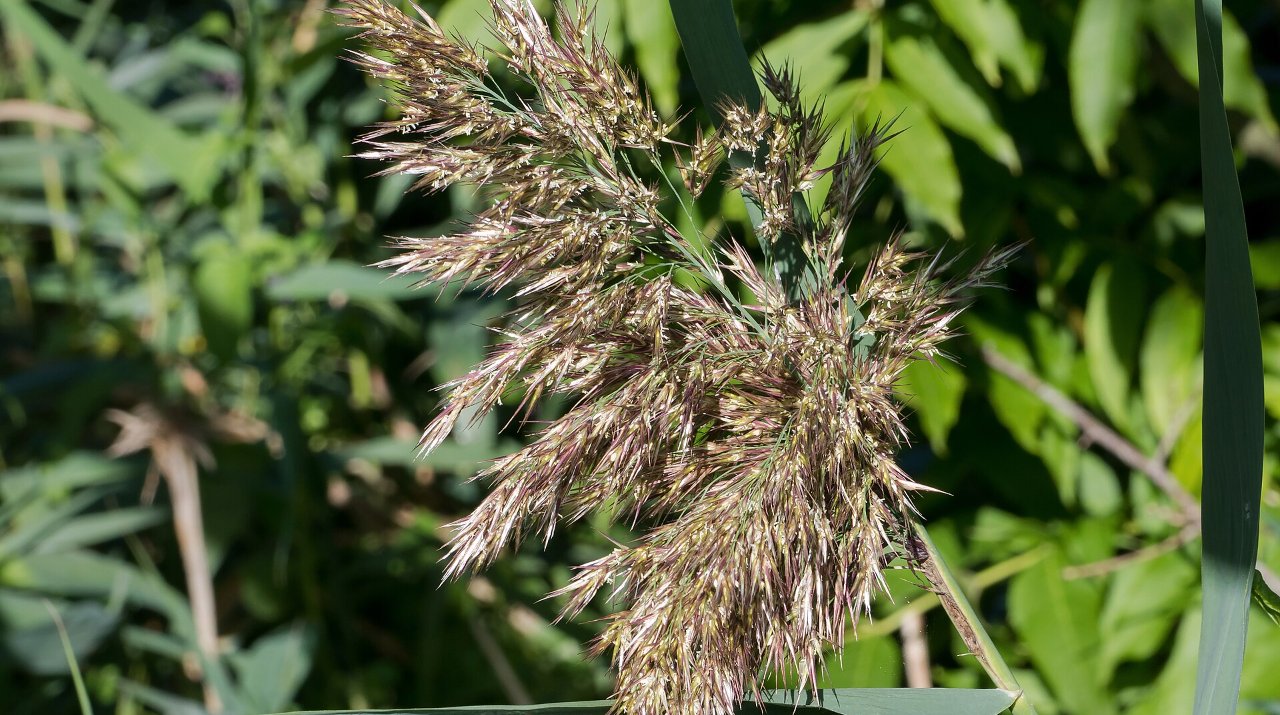
Common Reed is a very tall, perennial grass that forms dense stands along lakes, rivers and seashores. It has strong, cane‑like stems and a large feathery flower head that turns from purple‑brown to paler and drooping. You can see it across much of the world wherever shallow water and wet shores occur.
Did you know?
- Reedbeds shelter many birds; some nest only in them.
- People have long used common reed for roof thatching and insulation.
About the species
Identification
A very tall grass, usually 1–3 m. Stems are stiff, upright and hollow like canes, with solid joints. Leaves are long, flat, 1–2 cm wide, grey‑green, pointed, with sharp edges. The flower head is a dense, 10–30 cm feathery plume, first purplish or brownish and upright, later paler and drooping. Small grains follow. Easy to tell from look‑alikes: cattails have thick brown “sausages” instead of plumes, and club‑rushes have round, almost leafless stems. Flowers in Finland in late summer, mainly July–August.
Plant group
Grasses, sedges and rushes
Habitat
water
Flowering
Jul–Aug
About the habitat
Grows in shallow water and on wet shores of lakes, rivers and the sea, along ditches and the edges of marshes; favors nutrient‑rich sites and often forms extensive reedbeds. Common almost throughout the country; rare only in northernmost Lapland.
Sources
Photo: W.carter, CC0 https://commons.wikimedia.org/wiki/File:Reed panicle at Brodalen 1.jpg
Text: Pinkka: BIO-503 Suomen kasvisto ja kasvillisuus - Sisävedet: humusjärvet, CC BY 4.0 https://laji.fi/taxon/MX.40639
Text: Wikipedia (Finnish), CC BY-SA 4.0 https://fi.wikipedia.org/wiki/J%C3%A4rviruoko