 Suomi
 Svenska
Clustered Bellflower
Campanula glomerata
Identify the Clustered Bellflower from a photo and log your finds with Florapass.
Coming soon to the App Store and Google Play.
Alien species
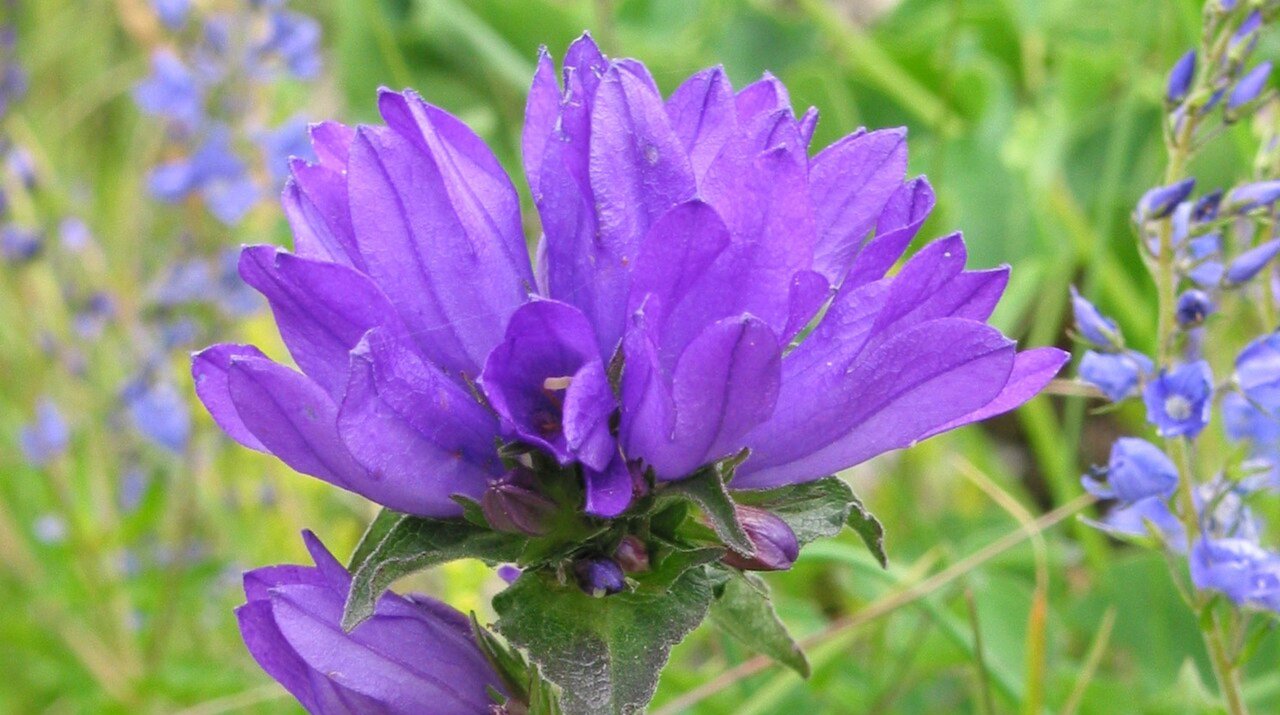
Clustered Bellflower is a medium-tall perennial with tight heads of purple‑blue bells. It is most often seen on meadows, grassy slopes and roadsides, and also escapes from gardens. The stiff, usually unbranched stem can be dark reddish-brown.
Did you know?
- The flowers sit in packed, head-like clusters that give the plant its name.
- It can spread quite strongly by runners and is also grown in gardens with large-flowered forms.
About the species
Identification
Perennial herb (milky juice if broken), 20–80 cm tall. Stem upright, usually unbranched, often dark reddish-brown, nearly smooth or slightly hairy. Basal leaves usually withered by flowering. Stem leaves go up the stem one by one, narrow oval to long oval, finely toothed, hairy on both sides; lower ones with stalks, upper ones stalkless and often partly wrap around the stem. Flowers form a dense rounded cluster at the top, with smaller clusters in the upper leaf joints; bells 1.6–3 cm, deep blue to violet-blue (rarely white). Later, dry capsules release seeds through tiny holes. Can be confused with Bristly Bellflower, which is much rougher and bristly and usually lacks the extra side clusters. Flowers in Finland from June to August.
Plant group
Herbaceous plants
Habitat
meadow
Flowering
Jun–Aug
About the habitat
Sunny to half-shady places such as meadows, grassy slopes, field margins, and light, fresh woods. Widespread in southern Finland as an ancient introduction; introduced more recently in Ostrobothnia, Kainuu and Kittilä.
Sources
Photo: Robert Flogaus-Faust, CC BY 4.0 https://commons.wikimedia.org/wiki/File:Campanula glomerata 2 RF.jpg
Text: Pinkka: BIO-503 Suomen kasvisto ja kasvillisuus - Kulttuuriympäristöt: hakamaat, CC BY 4.0 https://laji.fi/taxon/MX.39705
Text: Pinkka: IPS-177 Fennoscandian flora - Cakile-Carum, CC BY 4.0 https://laji.fi/taxon/MX.39705
Text: Wikipedia (Finnish), CC BY-SA 4.0 https://fi.wikipedia.org/wiki/Peurankello