 Suomi
 Svenska
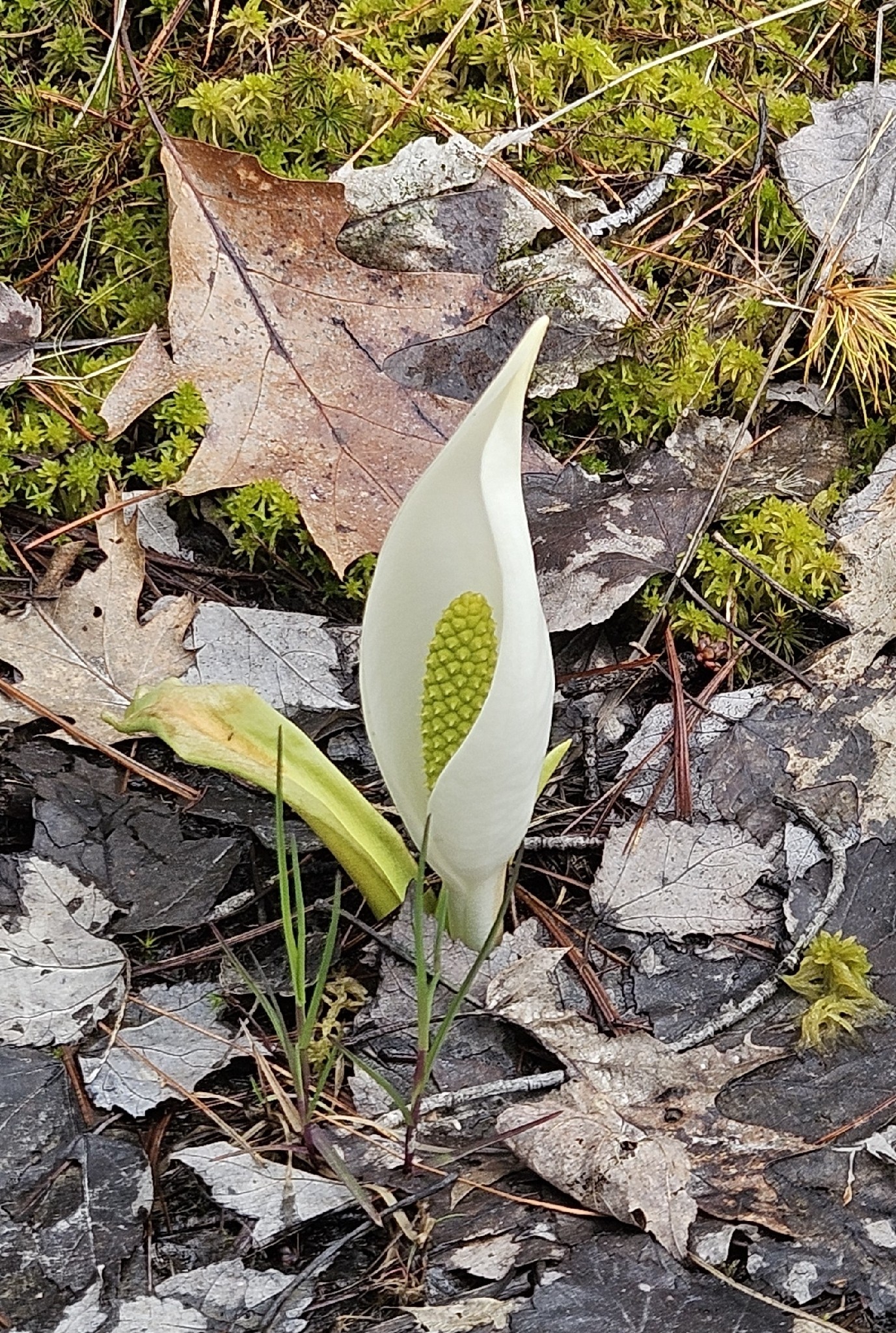
Bog Arum
Calla palustris
Identify the Bog Arum from a photo and log your finds with Florapass.
Coming soon to the App Store and Google Play.
Bog Arum is a low wetland plant found in bogs and along quiet waters across the cooler parts of the Northern Hemisphere. It has shiny heart‑shaped leaves and a white hood that wraps a short club of tiny flowers, which later turn into bright red berries. All parts are poisonous.
Did you know?
- It is the only species in its group (Calla).
- The bright red fruits can float and spread by water.
About the species
Identification
A 15–40 cm tall wetland plant from a thick creeping underground stem. Leaves rise on long stalks, shiny and heart‑shaped, about 5–10 cm, forming a loose clump. At the tip of the shoot is a short finger‑like club of tiny flowers (about 2–3 cm) wrapped in a single oval hood: greenish outside, bright white inside. Later the hood withers and the club becomes a tight cluster of bright red, angular berries. Key signs: white hood with heart‑shaped leaves standing above the water. Not like water‑lilies, whose round leaves float. Flowers in Finland in June–July.
Plant group
Herbaceous plants
Habitat
mire
Toxicity
A poisonous plant – do not taste it. Source: HUS Poison Information Centre (Finland), tel. 0800 147 111.
Flowering
Jun–Jul
About the habitat
Grows in very wet, peaty places: bogs, swampy woods, fens, and along streams, ditches, and the muddy edges of ponds and lakes. Often stands in shallow water. Common in South and Central Finland, rare in the North; absent from northernmost Lapland.
Sources
Photo: Mike Zifkin, CC BY 4.0 https://www.gbif.org/occurrence/6251447147
Text: Pinkka: Laaja maatalouslajintuntemus 4 op - Koppisiemeniset, CC BY 4.0 https://laji.fi/taxon/MX.40092
Text: Pinkka (Luomus), CC BY 4.0 https://laji.fi/taxon/MX.40092
Text: Wikipedia (Finnish), CC BY-SA 4.0 https://fi.wikipedia.org/wiki/Suovehka