 Suomi
 Svenska
Baneberry
Actaea spicata
Identify the Baneberry from a photo and log your finds with Florapass.
Coming soon to the App Store and Google Play.
Baneberry is a 30–60 cm tall woodland plant with small white flowers and shiny black berries. It grows in rich, shady forests across much of Europe and parts of western Asia. The whole plant, especially the berries, is very poisonous.
Did you know?
- Where it grows with red baneberry, rare hybrids can appear with dark red, oddly shaped berries.
- Its berries were once boiled with alum to make ink.
About the species
Identification
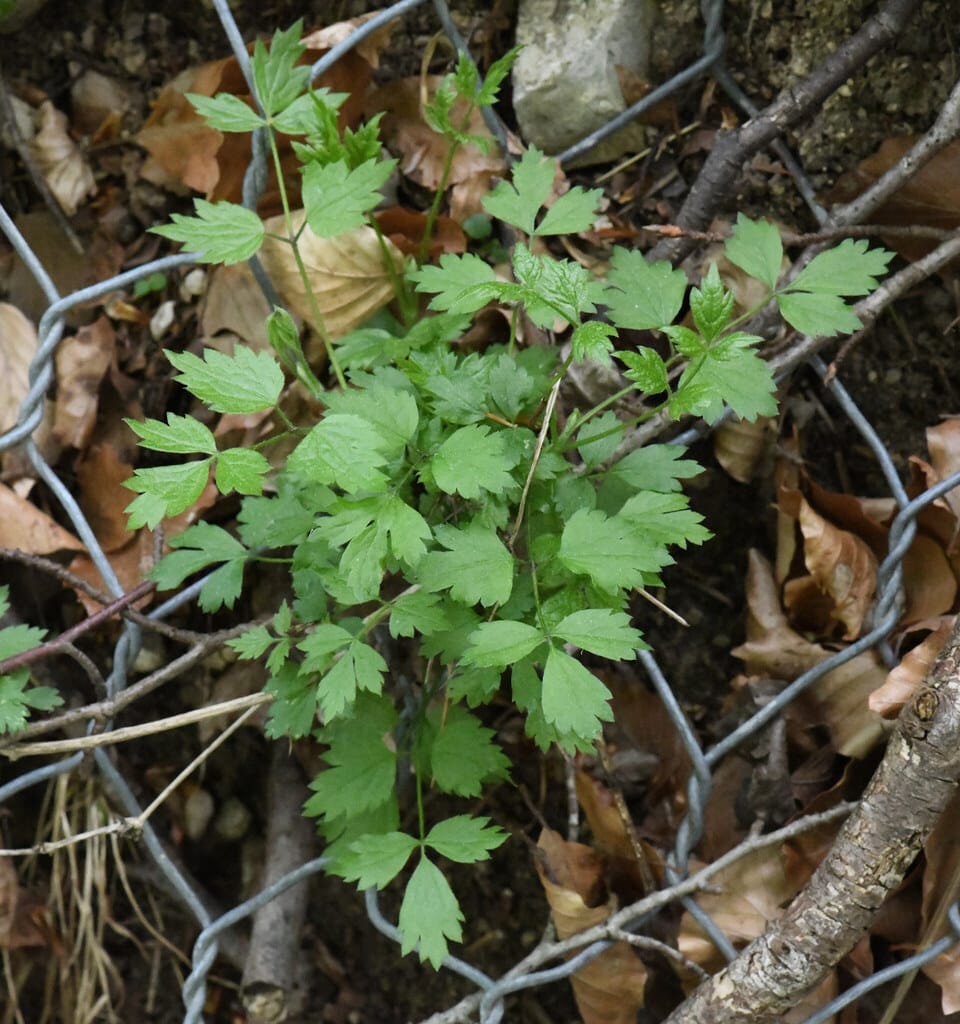
Upright plant 30–60 cm tall. Leaves large and triangular overall, up to 40 cm wide, divided into many smaller leaf parts with toothed edges; the end part is often heart‑based. A short, upright, dense cluster of small white to slightly pink, faintly scented flowers; often a few single flowers just below. Later it carries shiny, oval black berries about 1–1.4 cm. Do not confuse with bilberries: baneberry fruits stand on stalks above the leaves, not on low shrubs. Red baneberry is similar but has red fruits. Flowers in Finland in June.
Plant group
Herbaceous plants
Habitat
herb-rich forest
Toxicity
A poisonous plant – do not taste it. Source: HUS Poison Information Centre (Finland), tel. 0800 147 111.
Flowering
Jun
About the habitat
Grows in rich, shady broadleaf woods and on rocky or stony slopes; prefers fresh to slightly dry ground and often lime‑rich soils. Common in southern and southwestern Finland; rarer farther north.
Sources
Photo: Matteo Martini, CC BY 4.0 https://www.gbif.org/occurrence/6235329951
Text: Pinkka: Kasvitieteen retkeily Ahvenanmaalle - Nåtö ja Västerskog, CC BY 4.0 https://laji.fi/taxon/MX.37859
Text: Pinkka (Luomus), CC BY 4.0 https://laji.fi/taxon/MX.37859
Text: Pinkka: IPS-177 Fennoscandian flora - Acer-Butomus, CC BY 4.0 https://laji.fi/taxon/MX.37859
Text: Wikipedia (Finnish), CC BY-SA 4.0 https://fi.wikipedia.org/wiki/Mustakonnanmarja